

Five VP&S Faculty Named to National Academy of Medicine
Five faculty of Columbia University Vagelos College of Physicians and Surgeons were elected to the National Academy of Medicine among this year’s class of 100 new members.
Election to the academy is considered one of the highest honors in the fields of health and medicine and recognizes individuals who have demonstrated outstanding professional achievement and commitment to service.
The National Academy of Medicine has 2,600 members who help the academy provide independent, objective analysis and advice to the nation on critical issues in health, science, medicine, and related policy.
The new Columbia members are:
- Cory Abate-Shen, PhD, professor of molecular pharmacology and therapeutics and the Robert Sonneborn Professor of Medicine
- Noémie Elhadad, PhD, chair of the Department of Biomedical Informatics, associate professor of biomedical informatics, and vice dean for artificial intelligence initiatives
- Ali Gharavi, MD, chair of the Department of Medicine, Harold Ames Hatch (II) Professor of Medicine, and director of the Center for Precision Medicine and Genomics
- Meghan Brooks Lane-Fall, MD, the E.M. Papper Professor and Chair of Anesthesiology
- Bing Ren, PhD, professor of genetics and development and associate director of the Vagelos Institute for Basic Biomedical Science
Read more below.
Cory Abate-Shen, PhD

Abate-Shen was named for “her work in developmental oncobiology and for seminal discoveries elucidating molecular mechanisms driving cancer. Her innovative use of genetically engineered mouse models has transformed understanding of tumor initiation, progression, and metastasis, informing improved diagnostic and therapeutic strategies across genitourinary cancers.”
In her prostate cancer research, Abate-Shen has developed a suite of genetically engineered mouse models that recapitulate the full spectrum of disease, from pre-invasive lesions to metastatic cancer. Studies using these models have identified lineage plasticity as a key mechanism of treatment resistance, elucidated mechanisms driving metastatic progression, and revealed potential therapeutic targets for bone metastasis.
Abate-Shen has also led a multidisciplinary collaborative team studying bladder cancer, and her laboratory has pioneered approaches to target gene recombination specifically to the bladder urothelium. These advances have enabled the generation of mouse models of muscle-invasive and metastatic bladder cancer and have supported clinical trials that are informing the treatment of patients with high-risk disease.
Cory Abate-Shen is professor of molecular pharmacology and therapeutics and the Robert Sonneborn Professor of Medicine at Columbia University’s Vagelos College of Physicians and Surgeons, with additional appointments in the Departments of Urology and Systems Biology. She is also a member of Columbia’s Institute for Cancer Genetics.
In 2025, Abate-Shen was elected to the National Academy of Sciences.
Noémie Elhadad, PhD

Elhadad was named a member of NAM for “contributing foundational advances to the field of AI for health care, translating them into the clinic through decision support tools like patient record summarization, and for pioneering new approaches in patient-centered AI together with building large, global-scale patient-generated datasets to advance the knowledge and management of endometriosis and menstruation.”
Elhadad’s research combines artificial intelligence, human-centered computing, and medicine to design AI-driven tools that are safe, effective, and support patients and clinicians. She has designed methods to analyze consumers’ texts to uncover disease symptoms and medication side effects reported by patients and a system for clinicians that summarizes longitudinal patient records. In her work in women’s health, she has generated novel disease insights through large-scale community engagement and novel machine learning methods of health data.
Noémie Elhadad is chair of the Department of Biomedical Informatics, associate professor of biomedical informatics, and vice dean for artificial intelligence initiatives at the Vagelos College of Physicians and Surgeons. Under her leadership, Columbia has been at the forefront of AI’s impact on patient care and biomedical knowledge discovery, leading fundamental research on AI and developing programs to educate a wide array of learners in health-related AI.
Ali Gharavi, MD
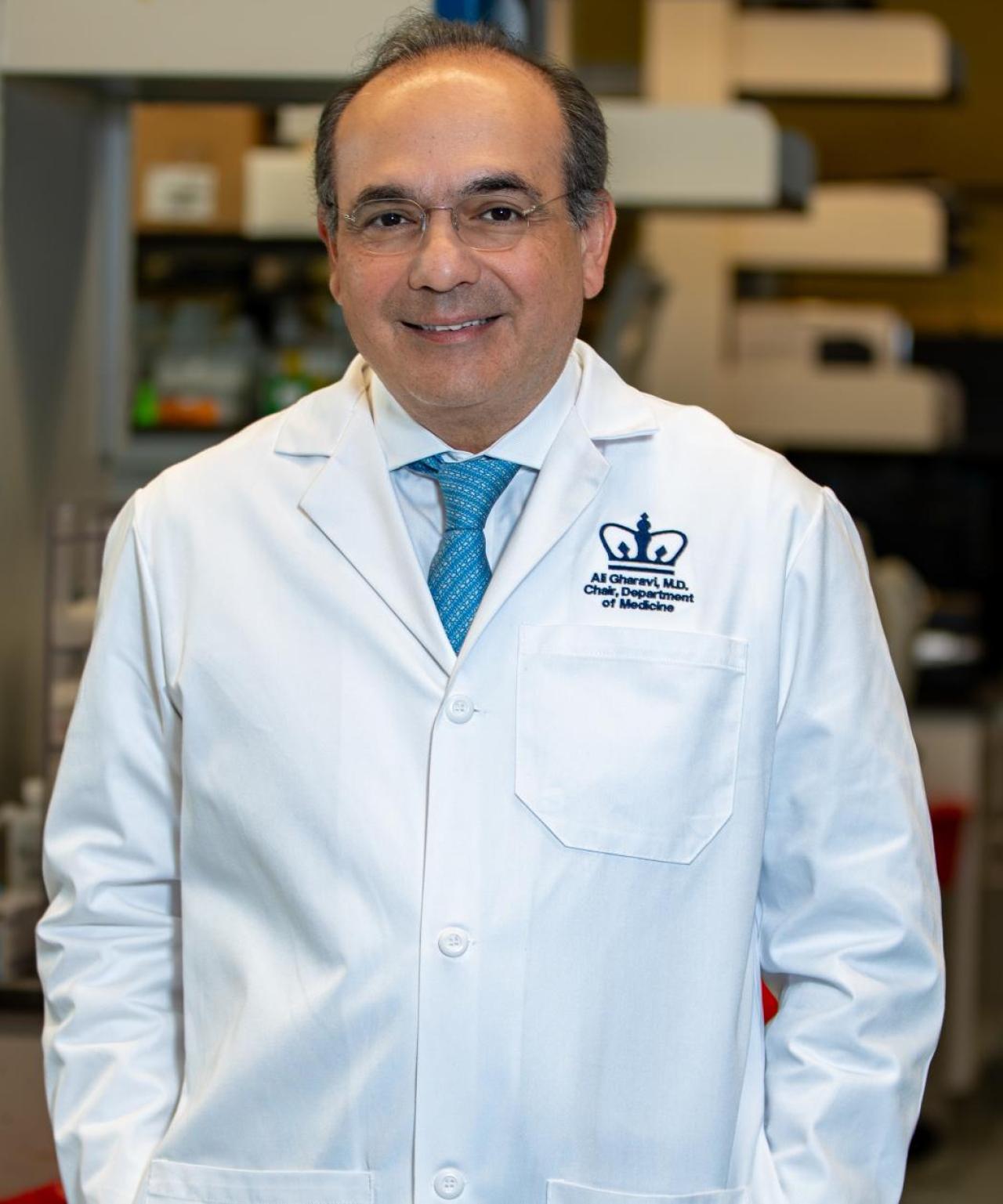
Gharavi was elected for “his research that clarified the genetics of numerous kidney disorders and enabled successful treatments for IgA nephropathy. By proving the value of genetic testing in otherwise idiopathic renal failure, he changed the paradigm of kidney care.”
After joining Columbia in 2003, Gharavi developed a research program focused on the molecular genetics of kidney diseases. His work has led to the discovery of many genes and risk loci for IgA nephropathy and congenital kidney defects. His research on IgA nephropathy identified new biological pathways that have been successfully targeted for treatment of this disease. His work has also demonstrated the utility of clinical sequencing for the diagnosis and management of patients with kidney disease, and under his guidance, the division of nephrology established a pioneering program for precision nephrology.
Gharavi is the chair of the Department of Medicine, the Harold Ames Hatch (II) Professor of Medicine, and director of the Center for Precision Medicine and Genomics. His goal is to bring personalized genomic medicine to all specialties of internal medicine.
Meghan Brooks Lane-Fall, MD

Lane-Fall was elected “for her expertise on the application of implementation science to maternal health research. Her NIH-funded research combines the science of organizational behavior change with human factors engineering to drive equity improvements in maternal care and outcomes in acute and community settings across the United States.”
Lane-Fall is an internationally recognized anesthesiologist, critical care physician, and implementation scientist who has led innovative research to advance perioperative safety, health equity, maternal health, and population health.
As an implementation scientist, she explores the barriers that prevent the adoption of effective clinical practices and combines implementation science and human factors engineering to promote the uptake of evidence-based practices. Her early work identified variability and risks in clinical handoffs in ICUs that can lead to patient harm. Building on this work, she led teams in the design, testing, and implementation of standard protocols that guide handoffs, ensuring vital patient data is communicated.
Lane-Fall’s research in health equity and clinical disparities focuses on systemic flaws—including poor communication, capacity strain, lack of standard protocols, and workforce diversity—that impact vulnerable patient populations. Before joining Columbia in 2025, she co-founded an NIH-funded hub at the University of Pennsylvania to address the factors that affect pregnancy-related complications and mortality, with a focus on populations that experience health disparities. She continues to co-direct the hub with collaborators at Penn.
Lane-Fall is the E. M. Papper Professor and Chair of Anesthesiology.
Bing Ren, PhD

Bing Ren is a pioneer in the field of epigenomics whose research has transformed our understanding of how genes are regulated and how DNA is organized within cells. His work has helped reveal how genes are switched on and off during development, how the three-dimensional organization of the genome influences gene activity, and how genetic variations contribute to human disease.
He was elected to the National Academy of Medicine for “developing transformative methods to map transcriptional regulatory elements and annotating millions of enhancers and promoters across hundreds of human cell types. He also helped establish that interphase chromosomes are organized into topologically associating domains, which constrain enhancer-promoter interactions and shape gene regulation.”
Ren has played a central role in major international genomics initiatives, including the ENCODE Project, the NIH Roadmap Epigenomics Mapping Consortium, the 4D Nucleome Consortium, and the BRAIN initiative Cell Atlas Network (BICAN). More recently, his research has produced detailed maps of the different cell types in the human and mouse brain, revealing how the brain changes with age and providing new insights into neurodegenerative diseases such as Alzheimer's disease.
Ren is a professor of genetics and development at Columbia University's Vagelos College of Physicians and Surgeons, with additional appointments in the Departments of Biochemistry and Molecular Biophysics and Systems Biology. He is also associate director of the Vagelos Institute for Basic Biomedical Science, and scientific director and CEO of the New York Genome Center. Through these roles, he is working to advance genomic discoveries and technologies that will deepen our understanding of human disease and help lay the foundation for more precise approaches to disease prevention and treatment.