
2026 Horwitz Prize Awarded for Work on Epigenetics in Neurological Diseases
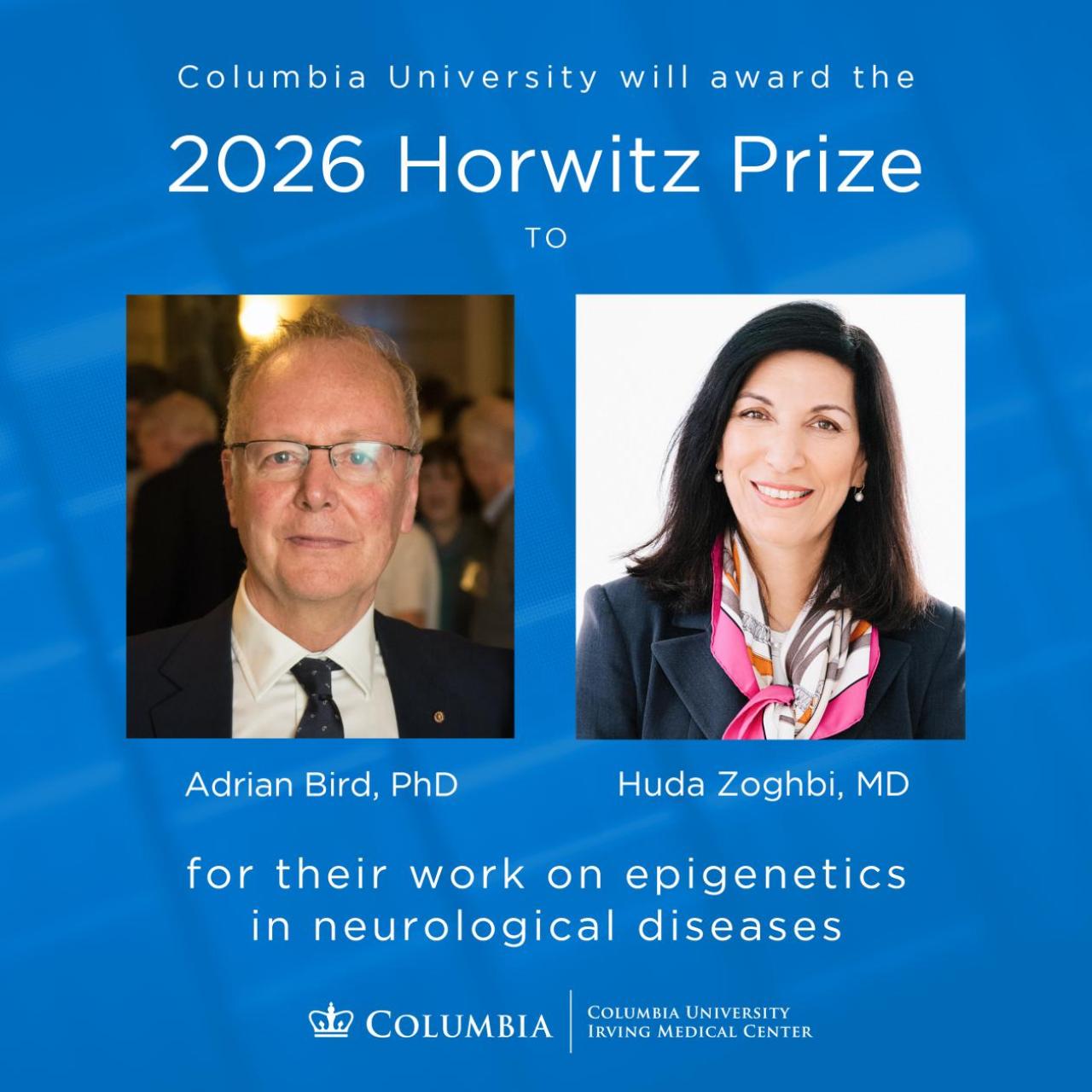
NEW YORK, NY (September 2, 2026) — Columbia University will award the 2026 Louisa Gross Horwitz Prize to Adrian Bird and Huda Zoghbi for their pioneering work on epigenetic regulation in the nervous system and its role in human neurological disease, particularly Rett syndrome. Bird and Zoghbi’s work reshaped how scientists understand the roots of brain disease, showing that problems with gene regulation, not just gene mutation, can drive severe developmental conditions.
Primarily affecting girls, Rett syndrome is a severe neurodevelopmental disorder that impacts nearly every aspect of life, including the ability to speak, walk, control hand movements, eat, breathe, think, and control seizures. Before the discoveries of Bird and Zoghbi, the disorder was poorly understood and considered untreatable. Their work has inspired international efforts to develop genetic therapies, culminating in a series of ongoing clinical trials.
Bird uncovered key principles of epigenetic regulation, a chemical process that turns genes on and off without altering their underlying code. In the 1980s, he discovered CpG islands, specialized DNA clusters present near the start of genes. A decade later, his lab identified MeCP2, a protein that scans for chemical tags called methyl groups attached to these clusters and, upon finding them, switches the nearby gene off, acting like a molecular "off switch" for gene activity in neurons and throughout the body.
Zoghbi discovered in 1999 that mutations in MeCP2 cause Rett syndrome, establishing the first direct link between epigenetics and a severe neurological disorder and enabling early detection of the disease by genetic testing. She also showed that MeCP2 levels must be precisely maintained for neurons to function normally. Too little MeCP2 causes Rett syndrome, while doubling MeCP2 levels causes neurological deficits. Later work revealed that MeCP2 mutations also contribute to a range of other neurological conditions, from autism to juvenile-onset schizophrenia.
Though Rett syndrome was thought to cause permanent brain damage, Bird and Zoghbi showed that it could be reversible. Bird's group engineered the first mouse model of Rett syndrome and, in 2007, showed that reactivating MeCP2 in these mice dramatically improved neurological symptoms. Zoghbi’s team showed that the effects of abnormal levels of functional MeCP2 can be reversed in mice by oligonucleotide therapy. Based on this groundbreaking work, a new generation of gene replacement (TSHA-102 and NGN-401) and RNA-regulating (ION 440) drugs are now advancing through clinical development.
“Together, these two scientists have forged a remarkable path from fundamental discovery to therapeutic possibility, exemplifying the highest ideals of biomedical research,” said Laura Landweber, chair of Columbia's Horwitz Prize committee.
“Their collective work has transformed our understanding of the molecular basis for a significant human disease and brought renewed hope to patients and families affected by devastating neurological disorders,” added Henry Colecraft, a member of the prize committee.
Bird and Zoghbi are the 122nd and 123rd winners of the Horwitz Prize, which is awarded annually by Columbia University for groundbreaking work in medical science. Of the 121 previous Horwitz Prize winners, 55 have gone on to also receive Nobel Prizes.
Awardee Biographies
Adrian Bird, PhD, holds the Buchanan Chair of Genetics at the University of Edinburgh. He obtained his PhD in Edinburgh and, following postdoctoral experience at the Universities of Yale and Zurich, he joined the Medical Research Council’s Mammalian Genome Unit in Edinburgh. In 1987 he moved to Vienna to become a Senior Scientist at the Institute for Molecular Pathology. Returning to Edinburgh in 1990, he became founding Director of the Centre for Cell Biology (1999 to 2011), a governor of the Wellcome Trust and subsequently a trustee of Cancer Research UK. He is a Fellow of the Royal Society and a Foreign Associate of the US National Academy of Sciences. Awards include the Louis Jeantet, Gairdner, Shaw and the Brain Prizes and he was knighted in 2014.
Huda Zoghbi, MD, is a Distinguished Service Professor at Baylor College of Medicine, Investigator with the Howard Hughes Medical Institute, and founding Director of the Jan and Dan Duncan Neurological Research Institute at Texas Children’s Hospital. Zoghbi graduated from the American University of Beirut, received her medical degree from Meharry Medical College, and completed her residency and postdoctoral research training at Baylor College of Medicine. She has been elected to the National Academy of Medicine, the National Academy of Sciences, and the American Academy of Arts and Sciences. Awards include the Gairdner, Shaw, Kavli, Breakthrough and the Brain Prizes.
References
About the Louisa Gross Horwitz Prize
The Louisa Gross Horwitz Prize was established in 1967 by the late S. Gross Horwitz in memory of his mother, Louisa Gross Horwitz, daughter of Philadelphia surgeon and American Medical Association president Samuel David Gross, MD. Columbia University has awarded the prize annually since then for outstanding contributions to knowledge in biology or biochemistry. Nearly half of the prize's past recipients have gone on to also win a Nobel Prize, most recently 2009 Horwitz laureates Victor Ambros, PhD, and Gary Ruvkun, PhD, who shared the 2024 Nobel Prize in Physiology or Medicine for their discovery of microRNA and its role in gene regulation. For a list of previous Horwitz Prize awardees, visit the Horwitz Prize page.
Details on the 2026 Louisa Gross Horwitz Prize lectures and dinner will be shared on the Horwitz Prize lecture website.
More information about the Louisa Gross Horwitz Prize
More information about the Louisa Gross Horwitz Prize recipients
More information about the Louisa Gross Horwitz Prize lectures
About Columbia University Irving Medical Center
Columbia University Irving Medical Center provides international leadership in basic, preclinical, and clinical research; medical and health sciences education; and patient care. The medical center trains future leaders and includes the dedicated work of many physicians, scientists, public health professionals, dentists, and nurses at the Vagelos College of Physicians and Surgeons, the Mailman School of Public Health, the College of Dental Medicine, the School of Nursing, the biomedical departments of the Graduate School of Arts and Sciences, and allied research centers and institutions. Columbia University Irving Medical Center is home to the largest medical research enterprise in New York City and State and one of the largest faculty medical practices in the Northeast. Columbia University Irving Medical Center shares a campus with its hospital partner, NewYork-Presbyterian. For more information, visit cuimc.columbia.edu.